You got the reading list. One of the "readings" is a 74-minute interview. The professor wants a quote. Spotify will play the episode, and if you are lucky it shows a transcript you cannot copy.
Listening is fine for the gist. It is a bad way to find one sentence again, or to mark up an argument the way you would mark up a PDF. Podcast transcription for students is mostly that job: get a public episode into text you can search, skim, and cite.
This is not the general tool roundup. That lives in best podcast transcription tools. It is also not the methods piece on coding transcripts in qualitative software, which is podcast transcripts for research.
Quick answer: Copy the episode link, paste it into Podtyper, and read the transcript with timestamps. Export TXT or PDF if you want the file in your notes. The first 30 minutes are free, no card.
Why a podcast is an awkward assignment
A chapter has pages. A paper has paragraphs. A podcast has a progress bar.
Notes taken while it plays always lag the sentence you wanted. Scrubbing back means guessing the minute. Spotify's transcript, on episodes that have one, stays inside Spotify. Apple's is the same idea: useful on the bus, useless as a document you can highlight and drop into a paper.
Turn the episode into a file, then study the file.
What to use
For a published episode, paste the link. Podtyper takes a public Spotify, Apple Podcasts, or YouTube URL. You do not download the audio, and you do not need the show's RSS feed.
What comes back:
- The full transcript, with timestamps when the recording supports them
- Search on the transcript page
- A summary, key takeaways, topics, and a few notable quotes
- Speaker labels when the audio separates voices
- Export as PDF, TXT, SRT, or VTT
Most episodes are ready in a few minutes, including hour-long shows. On clean audio, word-level accuracy is typically 99%+. That still leaves room to botch a surname, a paper title, or a stretch where two people talk at once. Play the timestamp before you put a sentence in anything with your name on it.
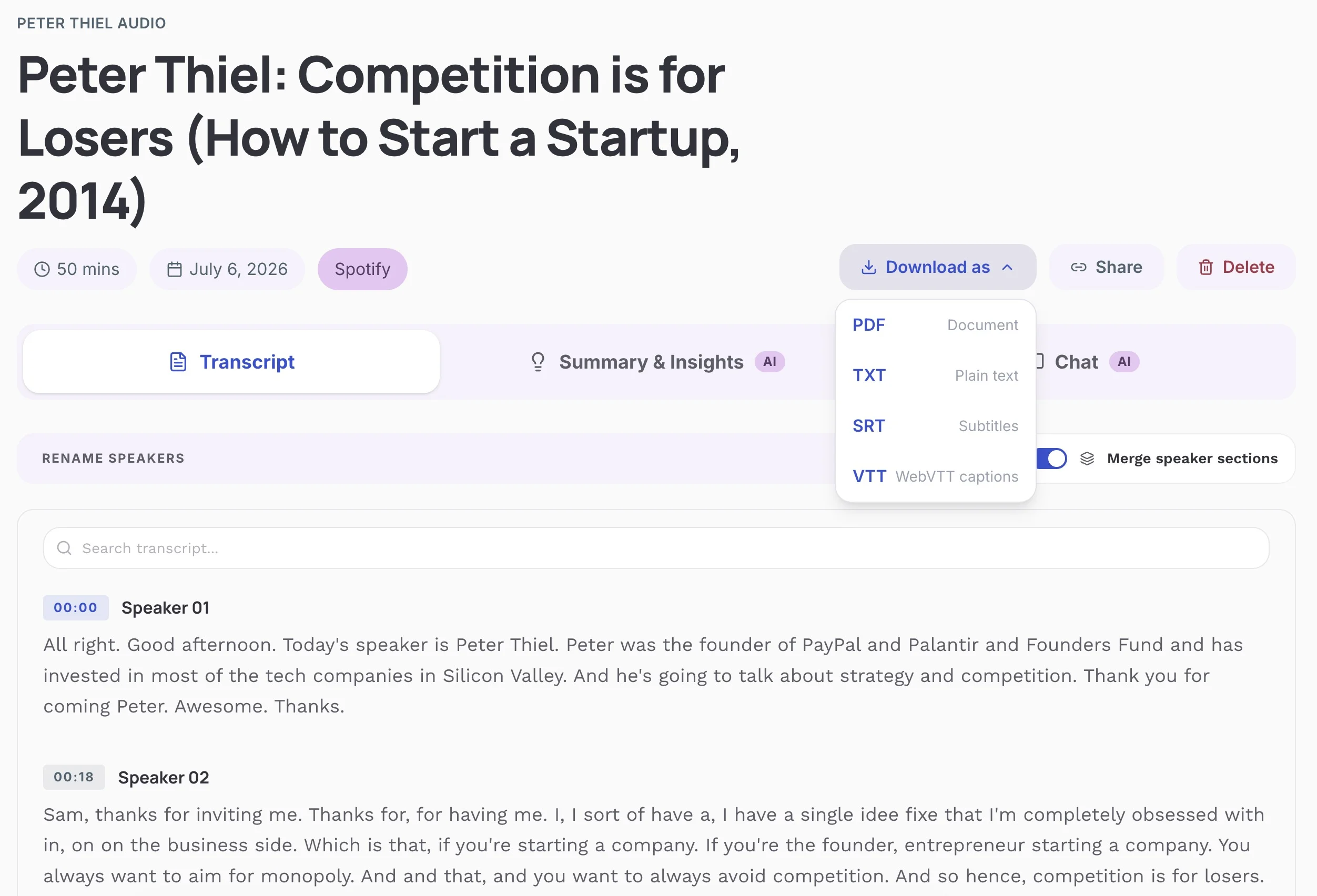
Rename speakers if they come back as Speaker 1 and Speaker 2. The show notes usually have the real names. Do not invent a name the model guessed.
The free plan is the first 30 minutes, no card. One short episode often fits. A weekly pile of seminars will not. Paid plans start at $9.99/month for 800 minutes. Premium is $24.99/month for 3,000 minutes. Details are on pricing.
Getting the link:
- Desktop: Share, then copy link to episode
- Phone: the share menu, then copy link
Paste it on podtyper.com.
How to turn the transcript into something you can study
Get the text first. Then decide what the assignment actually asked for.
A quote for a paper: search the transcript, copy the line, note the timestamp. Cite the episode (show, host, title, date). The transcript is how you found the line. The episode is the source. If the wording matters, play that moment once. PDF and TXT downloads include a note that the transcript is AI-generated and may contain mistakes. People skip that note and paste the quote anyway.
Exam notes: the summary is a map, not the notes. Read it, then pull the two passages you would actually be asked about. A generated summary will sand off disagreement. Seminars are often about the disagreement. If you only wanted the short version before deciding to listen, how to get a podcast episode summary is the shorter path.
Remembering it next month: the transcript is raw material for cards, not a deck by itself. The separate walkthrough is learning from podcasts with flashcards. A card for every sentence is how you build a deck you will never open.
One phrase in a long episode: search on the page. A pile of episodes: export TXT and search the files. That workflow is in how to search inside a podcast.
What I would skip
Typing the episode out while you listen. It feels serious. You still miss lines, and it takes as long as the episode.
A meeting tool, if the source is already a published link. Those want an upload or a live call. You already have a URL.
Descript, if you are not cutting the audio. It is a production app. You are trying to finish a reading.
The built-in Spotify or Apple transcript, if you need to copy anything. Follow along with it. Do not fight it for a citation.
A human transcription service, unless one wrong word would be a real problem. For class, check the lines you cite.
How the options compare
| Method | Start from a link | You can copy the text | Summary | Fit for class |
|---|---|---|---|---|
| Podtyper | Yes | Yes | Yes | Reading, search, quotes |
| Spotify or Apple transcript | Already in the app | No | No | Following along |
| Notes while listening | No | Your notes only | Whatever you wrote | Easy to miss the line |
| Meeting transcription tool | Usually an upload | Yes | Often | Recorded classes, not episode links |
| Human transcription | If you have the file | Yes | No | Quotes you cannot afford to get wrong |
A couple of real study situations
Seminar. The host and the guest disagree about a paper. You want both positions, not a blended paragraph. Search the paper title or the guest's name, read that stretch, and quote the disagreement. If the title comes out garbled, the model missed a proper noun. Look the paper up. Do not build a citation from the bad line.
Learning the vocabulary of a field before the papers make sense. A science show such as Huberman Lab gets assigned this way a lot. Treat the transcript as notes. Anything that sounds like a dose, a study result, or a medical claim gets checked against the paper, not against the host. If you are in medical school and the episode is a journal club, the closer guide is podcast transcription for doctors.
Group project. One person runs the episode, exports PDF, and puts it in the shared folder. Everyone else can stop saying they "heard something about" the conclusion. You can still argue about what it means.
Frequently asked questions
What is the best podcast transcription tool for students?
For a public episode you need to read, search, and quote, use Podtyper. Paste the Spotify, Apple Podcasts, or YouTube link. You get a timestamped transcript, a summary, and PDF or TXT export. Use a meeting tool if you are recording the class itself. Pay for a human transcript if a single wrong word would be a serious problem.
Can I transcribe a Spotify episode my professor assigned?
Yes, if the episode is public. Copy the link and paste it into Podtyper. Spotify's own transcript, when it exists, is for reading inside the app. You cannot copy it out.
Is the transcript accurate enough to quote in a paper?
Accurate enough to find the passage and draft the quote. Not accurate enough to paste without listening to that line. On clean audio, word-level accuracy is typically 99%+. Names, paper titles, and overlapping speech are where it slips. The PDF and TXT files say the transcript is AI-generated and may contain mistakes.
How much does podcast transcription cost for a student?
The free plan is the first 30 minutes, with no card. One shorter episode often fits. Paid plans start at $9.99/month for 800 minutes. Premium is $24.99/month for 3,000 minutes. A minute of audio uses a minute of quota.
Can I do this on my phone?
Yes. Copy the episode link from the share menu, open Podtyper in the browser, paste, and export when it finishes. You do not need the audio file saved on the phone.
Is it allowed to transcribe an episode for class?
Personal notes and research are generally fine. Republishing the full transcript, or handing in the whole episode as text, can be a copyright problem. Quote what you need and cite the episode.
Does Podtyper translate the episode into another language?
No. It transcribes the language spoken in the audio, and it detects that language automatically. If you need a translation, export the text and run that file through a separate tool.
You do not need to replay minute 52 because you think that was the sentence.
Transcribe an episode for class →
If the assignment is on Apple Podcasts, start with how to get an Apple Podcasts transcript. The broader product page is podcast transcription.