You start an episode. Somewhere around minute 12 you are in another tab, or the dishes, or a thought that was more interesting than the host. The audio kept going. Now you can replay the whole thing, which you will not do, or you can pretend you got it.
That is the practical case for podcast transcription for ADHD. A podcast is a straight line. You cannot skim it, and you cannot reopen it on page 4 the way you would a doc. A transcript is a doc. You can land in the middle, search the term you came for, and leave.
This does not treat ADHD, and it will not make a boring episode interesting. If audio is the wrong format today, text is a different format. That is the whole pitch.
If the real goal is remembering the episode next week, transcripts plus review cards are a second step: learning from podcasts with flashcards. If the episode was assigned for class, the student guide is about quoting and notes, which overlaps.
Quick answer: Copy the episode link and paste it into Podtyper. Read or search the transcript instead of scrubbing the audio. Jump to a timestamp only for the part you still want to hear. The first 30 minutes are free.
What audio demands that text does not
Listening asks you to stay in order, at someone else's pace, with no headings. Miss twenty seconds and the next point hangs off a sentence you did not hear. Pause too long and restarting feels like starting over.
People describe this in different ways. Some call it ADHD. Some just hate long interviews. I am not going to sort that out, and this site is not going to diagnose anyone. The mechanic is the same either way: the episode will not let you scan.
A transcript will. Search for the guest, the book, the drug, the argument. Read the paragraph. If it is nothing, move on. If it is the part you wanted, the timestamp is sitting there for a 30-second replay instead of a 70-minute one.
Spotify and Apple sometimes show a transcript in the app. You can tap a line and jump, which is genuinely useful, and you still cannot copy the text into the notes app where you will actually look at it later. The words stay attached to the player.
A workflow that does not require finishing the episode
Paste a public Spotify, Apple Podcasts, or YouTube link into Podtyper. No file download, no RSS feed.
Most episodes are ready in a few minutes, including hour-long shows. Then ignore the advice to "just listen carefully."
- Search the page for the reason you opened the episode
- Read that stretch. Skip the intro banter if the intro banter is why you wandered off
- Play the timestamp only if the wording matters or the model looks wrong
- Export TXT or PDF if you want the text somewhere that is not a browser tab you will lose
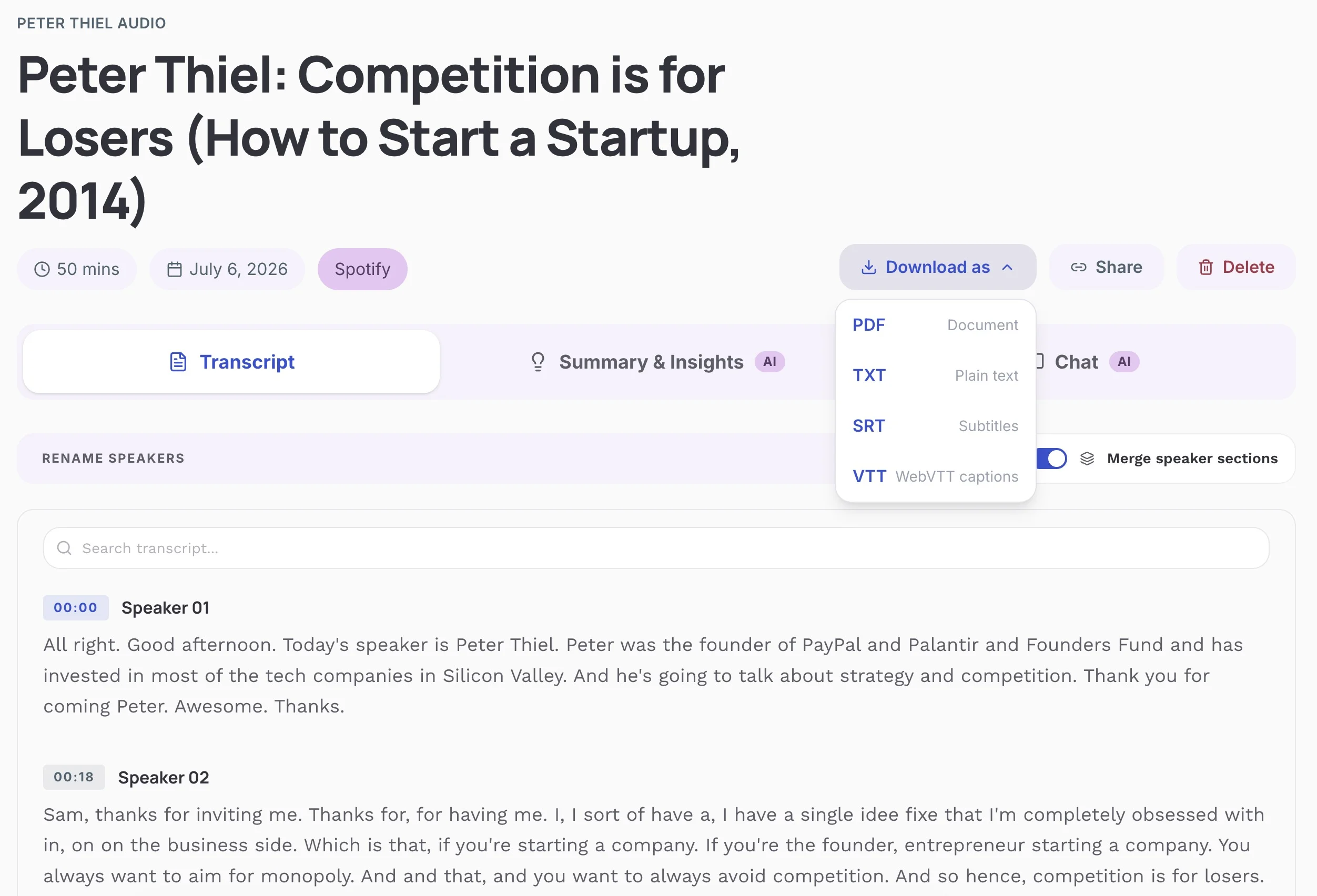
You also get a summary, key takeaways, topics, and a few quotes. I would read the summary the way you read chapter titles: to decide which part to open. I would not treat it as having "done" the episode. Summaries flatten arguments, and they invent a cleanliness the conversation did not have.
Speaker labels show up when the recording separates voices. They are often just Speaker 1 until you rename them. Fine for following who is talking. Not a reason to trust a name in the quote.
On clean audio, word-level accuracy is typically 99%+. Overlap, names, and background noise are the misses. If you are quoting someone, play the line. PDF and TXT files say the transcript is AI-generated and may contain mistakes.
The first 30 minutes are free, no card. That is enough to see if reading the episode is actually better for you than listening to it. Paid plans start at $9.99/month for 800 minutes. Premium is $24.99/month for 3,000. Pricing has the quotas. A minute of audio is a minute of quota, whether you listen or not.
Phone works. Copy the share link, open Podtyper in the browser, paste. You do not need the audio downloaded.
What this will not fix
If you also will not open the document, a transcript does not help. Some days the format is not the problem. I would rather say that than pretend a download creates attention.
It will not make every show worth reading. A rambling interview is still rambling in text. You can just confirm that faster and quit.
It is not medication. If a clinician gave you a plan, follow that. A transcript is only a different way to get through an episode.
It is also the wrong tool for a live meeting or a class you have to attend. Those need a meeting recorder or your own notes. Podtyper starts from a published episode link. The comparison of meeting tools versus podcast tools is in best podcast transcription tools.
And if what you wanted was one phrase you half-remember, you do not need a study system. Search the transcript. That is covered more generally in how to search inside a podcast.
How the options compare
| Way of getting through the episode | Skim | Search | Copy text out | Have to stay in order |
|---|---|---|---|---|
| Listening | No | No | No | Yes |
| Spotify or Apple transcript | A bit, if the show has one | Inside the app | No | No |
| Podtyper | Yes | Yes | Yes, PDF or TXT | No |
| Replay the episode | No | No | No | Yes, again |
Frequently asked questions
What is the best way to transcribe podcasts if you have ADHD?
Paste the public episode link into Podtyper and read or search the transcript instead of scrubbing the audio. Use timestamps to replay only the minute you care about. This is a format change, from audio to text. It is not a treatment.
Can a transcript help if I cannot finish episodes?
Often, yes, because you can start in the middle and search. It does not help if the text sits unopened too. Try one episode you already care about before you transcribe a backlog.
Does Spotify's transcript work for this?
Sometimes. On supported episodes you can read along and tap a line to jump. You cannot copy or export that text. If you need the words in your own notes, transcribe from the episode link.
Is this medical advice or an ADHD treatment?
No. Podtyper turns a public podcast into text. It does not diagnose, treat, or manage ADHD. Talk to a clinician about treatment. Use a transcript if you want the episode in a form you can scan.
How accurate is the text?
On clean audio, word-level accuracy is typically 99%+. Names and overlapping speech still go wrong. Play the timestamp before you repeat a quote. Exports note that the transcript is AI-generated and may contain mistakes.
How much does it cost?
The first 30 minutes are free, with no card. Paid plans start at $9.99/month for 800 minutes. Premium is $24.99/month for 3,000 minutes.
Can I use it on my phone?
Yes. Copy the episode link, open Podtyper in the mobile browser, and export when it finishes.
Read the part you opened the episode for. Replay a minute if you want the voice. Leave the rest.
Transcribe an episode you can actually read →
Same idea on other apps: Spotify transcripts and Apple Podcasts transcripts.