You are in the car. The host says a trial name, then a dose, then moves on. Twenty minutes later you remember the conclusion and not the drug. Rewinding a medical podcast by feel is how you miss the exit.
Podcast transcription for doctors means turning that public episode into text you can search. A journal club, a specialty update, an interview with the investigator. Find the name, check it, then go read the paper.
Podtyper takes a public Spotify, Apple Podcasts, or YouTube link. A visit, a consult, or anything you would put in the chart stays in the system your institution already uses. The link field on a podcast site is not a scribe.
Medical students doing this for a course, rather than for clinic, may want the student transcription guide as well. The research-methods version, including qualitative coding, is podcast transcripts for research.
Quick answer: Copy the public episode link, paste it into Podtyper, and search the transcript for the trial, the drug, or the guest. Export PDF or TXT if you want the file. Listen to any line you might repeat. The first 30 minutes are free.
Why audio is a bad index for medicine
Papers have titles, authors, and a methods section you can Ctrl+F. An episode has a slider.
The words you most need later are the ones speech-to-text is worst at: drug names, trial acronyms, dosages, gene symbols, author surnames. On clean audio, word-level accuracy is typically 99%+. A 1% miss concentrated in proper nouns is the whole problem. "Something-mab, twice weekly, I think" is not a note.
A transcript does not fix that by being magic. It gives you a string you can search, a timestamp you can play, and a file you can put next to the abstract. You still open the paper.
What to do with a public episode
Paste the link into Podtyper. Spotify, Apple Podcasts, and YouTube work when the episode is public. No RSS feed, no downloaded audio.
Most episodes are ready in a few minutes, including hour-long shows. You get:
- A full transcript, with timestamps when the recording supports them
- Search on the page
- A summary, key takeaways, topics, and notable quotes
- Speaker labels when voices separate
- PDF, TXT, SRT, or VTT export
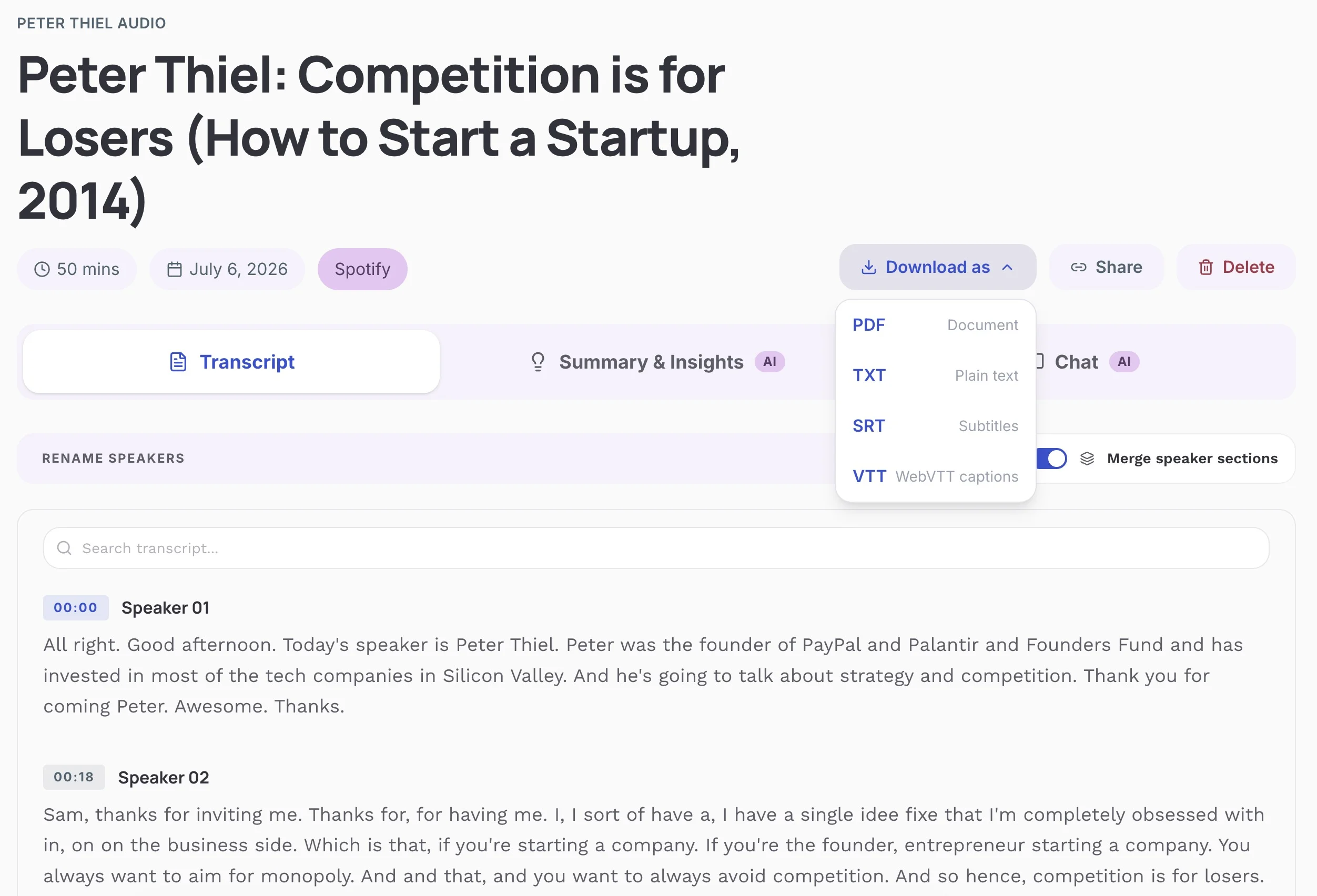
The summary is a map of the episode. It will happily smooth a "the data are suggestive" into something that sounds settled. Read the transcript around the claim, play the timestamp, then read the paper. If the drug name looks off, it probably is. Search the generic name in the transcript and in PubMed, not in your memory of the commute.
PDF and TXT downloads say the transcript is AI-generated and may contain mistakes. Leave that note alone if you forward the file to a resident. People paste.
Speaker labels, when they show up, still need the show notes. "Speaker 2" is not an affiliation.
The first 30 minutes are free, no card. Paid plans start at $9.99/month for 800 minutes. Premium is $24.99/month for 3,000 minutes, which is the one that fits a journal club plus whatever else you actually finish. Quotas are on pricing.
Language is detected from the audio. The tool transcribes. It does not translate. If you need another language, export the text and translate the file elsewhere.
Uses that fit, and one that does not
Journal club. Someone assigned the episode because nobody read the supplement. Transcribe it, search the trial acronym, and write down what the hosts emphasized. Then read the paper anyway. The episode is commentary. The paper is the source. If you are collecting several episodes, export TXT and search them together, which is the same method as how to search inside a podcast.
Teaching. A resident asks what the guest said about screening. Send the paragraph and the timestamp after you have played it. Do not send a generated summary as if it were a guideline. Summaries drop the hedge.
Catching up on a show you will not finish. A science interview show such as Huberman Lab is popular with trainees. Skim the transcript for the section you care about. Treat doses and protocols as claims to verify, not as orders.
Patient audio. No. Visits, consults, and anything with a patient's voice belong in the medical record system, under your institution's rules. A podcast transcription site is for published episodes. This post is not medical advice, and the transcript is not a reference for prescribing.
How the options compare
| Approach | Public medical podcast | Find a drug or trial name | Patient visit |
|---|---|---|---|
| Podtyper | Paste the link | Search, then verify | No |
| Spotify or Apple transcript | If the episode has one | Only inside the app, and you cannot copy it | No |
| Notes in the car | Whatever you remember | Unreliable | No |
| Reading the paper | Skip the episode | The actual source | No |
| A clinical scribe or your EHR | No | No | Yes, if your institution provides one |
Reading the paper is often the better use of the time. The transcript is for when the episode has the interview, the argument, or the aside that the abstract does not.
Frequently asked questions
What is the best podcast transcription tool for doctors?
For a public medical podcast you want to search, Podtyper. Paste the episode link and search the transcript, then check anything clinical against the paper. Do not use it for patient visits or as a clinical note.
Can I transcribe a journal club podcast from Spotify or Apple Podcasts?
Yes, if the episode is public. Copy the share link and paste it into Podtyper. You get a transcript, timestamps, a summary, and PDF or TXT export. The app's own transcript, when it exists, cannot be copied out.
Are drug names and dosages reliable in an AI transcript?
Often recognizable, not safe to repeat. On clean audio, word-level accuracy is typically 99%+, and drug names are a common part of the miss. Play the timestamp and confirm the name, the dose, and the schedule against the paper or the label. The export says the transcript may contain mistakes.
Can I use this for patient conversations or dictation?
No. Podtyper is for public podcast links. Patient audio and clinical documentation belong in the system your hospital or clinic already uses.
How much does it cost?
The first 30 minutes are free, with no card. Paid plans start at $9.99/month for 800 minutes. Premium is $24.99/month for 3,000 minutes. A 45-minute episode uses 45 minutes of quota.
Is the audio stored?
Audio is deleted from Podtyper's servers after processing. Transcripts are stored encrypted. That is for the public episode you submitted. It is not a reason to upload clinical recordings.
Does it translate medical episodes?
No. It transcribes the spoken language and detects that language from the audio. Translate the exported text afterward if you need another language.
Search the trial name, play that minute, then open the paper.
Transcribe a medical podcast →
The general how-it-works page is podcast transcription. If you only need the short version of an episode before deciding to listen, see how to get a podcast episode summary.